

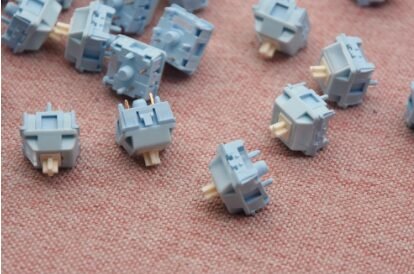
Three brands dominate the mechanical keyboard switch market: Cherry MX, Gateron, and Kailh. If you’re shopping for keyboard switches, you’ll encounter all three.
Each has its strengths, quirks, and die-hard fans. Here’s how they compare.
Cherry MX: The Original Standard
Cherry invented the modern mechanical keyboard switch in the 1980s. Cherry MX switches are the most widely recognized and most commonly found in pre-built keyboards.
Pros
· Proven reliability — Cherry’s quality control is exceptional. You’ll get consistent feel across every switch.
· Industry standard — Almost all keycap sets are guaranteed to fit Cherry MX stems
· Broadest compatibility — Works with every MX-style keycap and hot-swap socket
Cons
· Stock scratchiness — Cherry switches are among the scratchiest stock options. Hand-lubing is almost mandatory for a smooth feel.
· Less innovation — Cherry releases fewer new switch types than Gateron or Kailh
· Price — At $0.35–0.50 per switch, you’re paying for the brand name
Best Known For
· Cherry MX Red (linear, 45g) — The standard gaming switch
· Cherry MX Blue (clicky, 60g) — The classic clicky switch
· Cherry MX Brown (tactile, 45g) — The most popular switch worldwide
Gateron: The Smooth Alternative
Gateron (also known as “the Chinese Cherry clone”) started by reverse-engineering Cherry MX switches — but they quickly improved the formula. Today, Gateron is Cherry’s biggest competitor and arguably the better choice for most users.
Pros
· Smoother stock feel — Gateron switches are noticeably smoother than Cherry out of the box
· Better value — At $0.20–0.40 per switch, Gateron offers better price-to-performance
· More variety — Gateron produces dozens of switch variants (KS-3, KS-8, KS-9, Kustom series, Ink series, etc.)
· Works with Cherry MX stems — 100% compatible with Cherry keycaps and sockets
Cons
· Quality control variance — Budget Gateron switches can have minor inconsistencies between batches
· Legend of “scratchy base” — Older Gateron switches were scratchier; modern KS-3 and KS-9 series are excellent
Best Known For
· Gateron Yellow (linear, 50g) — The best value switch in the world
· Gateron Red (linear, 45g) — Budget alternative to Cherry Red
· Gateron Ink Black (linear, 60g) — Premium smooth linear
Kailh: The Innovator
Kailh (pronounced “kale”) is the most experimental of the three. They produce the widest variety of switch types and are known for pushing boundaries.
Pros
· Most innovative — Kailh created box switches (dust/water resistant), optical switches, low-profile switches, and magnetic Hall effect switches
· Box switch design — Kailh’s box switches have a sealed housing that prevents dust and liquid damage
· Crisp clicky switches — Kailh Box White and Box Jade have the best click mechanism on the market
Cons
· Stem compatibility issues — Early Kailh Box switches had stems that were slightly too thick, damaging keycaps. This was fixed in later batches, but the reputation persists.
· Less popular for linears — Kailh linear switches are good but not as smooth as Gateron’s offerings
· Availability — Some Kailh switch types are harder to find than Cherry or Gateron
Best Known For
· Kailh Box White (clicky, 50g) — Best clicky switch available
· Kailh Box Jade (clicky, 60g) — Heavier, louder clicky option
· Kailh Speed Silver (linear, 40g) — Short travel distance for gaming
· Kailh Box Navy (clicky, 70g) — Extremely heavy and loud
Direct Comparison
| Factor | Cherry MX | Gateron | Kailh |
| Price per switch | $0.35–0.50 | $0.20–0.65 | $0.25–0.50 |
| Stock smoothness | Moderate | Good–Excellent | Good |
| Lubed smoothness | Excellent | Excellent | Good |
| Linears | Good | Excellent (best in class) | Good |
| Tactiles | Good | Very Good | Good |
| Clicky | Good | Good | Excellent (best in class) |
| Variety | ~10 types | 50+ types | 100+ types |
| Compatibility | 100% MX | 100% MX | Mostly MX (check box stems) |
| Durability | 50M+ presses | 50M+ presses | 80M+ presses (box) |
| Best for | Reliability-seekers | Value/performance | Experimentation |
Which Brand Should You Choose?
Choose Cherry MX if:
· You want proven reliability and consistency
· You’re buying a pre-built keyboard and don’t plan to mod
· You value brand recognition and resale value
· You need the broadest compatibility guarantee
Choose Gateron if:
· You want the best price-to-performance ratio
· You’re building a linear-switch keyboard
· You plan to use the switches stock (without lubing)
· You want maximum value for your money
Choose Kailh if:
· You want clicky switches (Box White/Jade are unmatched)
· You’re building an outdoor or travel keyboard (box switches are weather-resistant)
· You want to try experimental switch designs
· You need optical or low-profile switches
The Truth No One Tells You
For most people, Gateron is the best choice. They’re smoother than Cherry out of the box, cheaper, and available in more varieties. The only areas where Cherry clearly wins are brand recognition and consistency guarantee.
Kailh’s clicky switches are the best in the world. Their linears and tactiles are good but not best-in-class.
And Cherry MX? They’re the safe choice. If you buy Cherry, you know exactly what you’re getting — and you’ll probably need to lube them.
Hybrid Recommendations
The best option? Mix and match. Use Gateron Yellows for the main alpha keys (smooth, cheap, great feel), Kailh Box Whites for the modifier keys you want to be clicky (Enter, Esc), and Cherry MX Clears for the spacebar (heavy, tactile).
But for most builds, a consistent switch type is the way to go. And that brings us back to Gateron.
____________________________________________________________
Ready to choose your switches? Browse our full collection of keyboard switches from all three brands.